

%20Net%20Yields.svg)


With harvest in storage, apple producers can celebrate what looks to be a production rebound in 2025. Unfortunately, some producers may require that increased production to help offset lower prices and higher costs. Prices have been stagnant for many apple varieties this year and modestly lower for others. Meanwhile, the hamster wheel of rising labor costs continued in 2025, putting relentless downward pressure on U.S. apple grower profit margins. While the recent rebound in export demand is providing hope for many growers, others remain on edge as the U.S. engages in trade discussions with numerous key export markets.
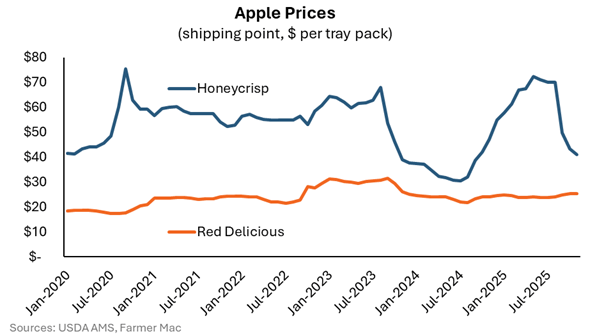
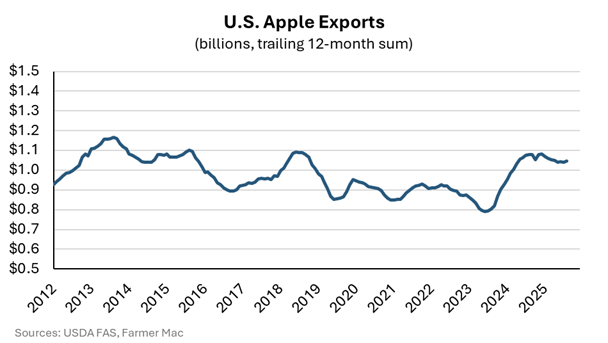
Following a year of modest price reprieve, apple growers enter the winter of 2025/26 in a period of heightened uncertainty. Apple prices rebounded momentarily during the 2024 crop year, albeit with a large variance across different varieties. Domestic apple consumption remains robust, especially for apple varieties that remain in vogue such as Honeycrisp. According to USDA AMS Market News, Honeycrisp farmgate prices more than doubled in 2024, while prices for Red Delicious and other classic varieties rose by more modest amounts. The price increases last year was partially a function of lower production. However, they also reflected a continued bounce back in global demand for U.S. apples. According to USDA FAS GATS, U.S. apple exports totaled more than $1 billion for the 2024 crop year, over 30% higher than 2023. Furthermore, 2024 was the first crop year since 2018 that exports surpassed $1 billion.
While the jump in export demand was welcomed by apple growers, maintaining consistent growth over the past decade has been a challenge. The U.S. apple industry has historically benefited from growing global demand for fresh produce, including apples. Estimates vary, but upwards of one-quarter of fresh apples harvested in the U.S. are exported in any given year. This proportion has grown through time as key markets such as Canada and Mexico have increased imports, helping absorb the growth in U.S. apple production and boosting prices. There are also several key markets outside of the immediate U.S. neighbors, including India and Japan.
Despite numerous tailwinds, exports have also been largely flat over the past decade. The U.S. is a global leader in apple genetics and helped pioneer numerous new varieties, including Honeycrisp, in the last several decades. These varieties have garnered a significant following among consumers both domestically and abroad, helping boost exports.
Unfortunately, periods of growth in apple exports over the past decade have been followed by setbacks. Trade disputes with key exporting countries have resulted in counter-tariffs on U.S. agricultural goods, including apples. Most famously, India was a top destination for U.S. apple exports before imposing counter-tariffs, leading to a 98% drop in imported U.S. apples the following year. Beyond trade disputes, the global supply chain disruption caused by COVID-19 also limited exporters’ ability to physically move apples overseas, even when demand existed. Finally, foreign competitors have been quick to capitalize on an inconsistent U.S. apple supply and have captured significant market share in the process.
While Prices Flatline, Labor Costs Continue to Climb
Apple producers continue to face the same significant hurdle that many other permanent crop producers have in the last several decades: labor. According to the USDA ERS Apple Sector Report, labor is the largest proportion of operating costs for specialty crop producers, accounting for nearly 40% over the past 10 years. This was over three times the same percentage for dairy, the next-closest production type. Estimates vary when examining apple labor costs because of differences in orchard types and varieties. However, the disparity persists and underscores an ongoing lack of mechanization across the apple sector and other specialty crops. While there is anticipation of mechanizing certain apple production tasks in the future—such as combining AI with advanced image sensors, which could expedite the rollout of mechanical harvesters—for now, mechanization is still particularly elusive for other tasks, and labor is likely to remain a key input component for apple growers for the foreseeable future.
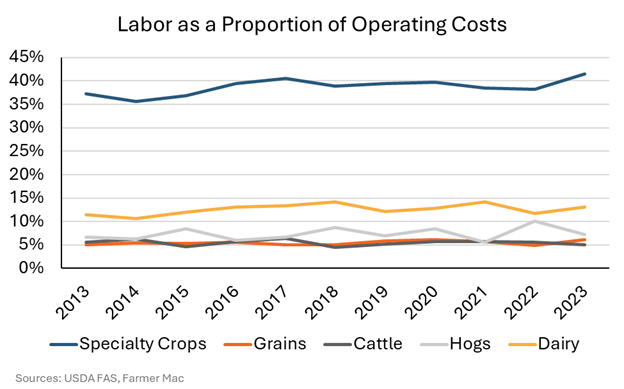
Beyond labor being the largest component for specialty crop producers, its overall share continues to increase at the fastest rate among all producer types. This is largely attributable to specialty crop producers’ reliance on the H-2A program, where wages are predetermined. The U.S. Department of Labor annually calculates the Adverse Effect Wage Rate (AEWR) as the minimum wage for H-2A workers. The AEWR is calculated for each state using USDA survey data, but tends to be higher than state and federal minimum wages. In the key apple-producing state of Washington, for example, the AEWR rose from $12.00 per hour in 2013 to $19.82 per hour in 2025, a 65% increase.
Conclusion
Apple growers have invested significantly in orchards over the past several decades, phasing out historic apple varieties for newer ones. Consumers have benefited from this investment, with an abundance of better-tasting varieties available in stores. However, farmgate apple prices have not increased fast enough to offset the surge in labor costs over the last decade, putting some growers in a precarious financial position. While the positive outlook for apple consumption is worth celebrating, a solution to the labor quagmire is likely to remain a top priority for many producers in 2026.
Appeared in the Winter 2025/2026 Issue
SOURCES:
- Apple Crop Enterprise Budgets
- Supplement to Adjusting to Higher Labor Costs in Selected U.S. Fresh Fruit and Vegetable Industries: Case Studies
- USDA ERS Tailored Reports
- USDA Agricultural Marketing Service Custom Query
- USD Foreign Agricultural Service GATS
Opinions, forecasts, estimates, projections and other views in this report constitute the current judgment of the author as of the date of this report, do not necessarily reflect the opinions of Farmer Mac or its management, and should not be construed as indicating Farmer Mac’s business prospects or expected results. The information contained in this report has been compiled from what Farmer Mac regards as reliable sources. Farmer Mac does not guarantee that the information provided in these materials is accurate, current or suitable for any particular purpose and Farmer Mac disclaims any responsibility for the information, third-party opinions, and data included in this report. Farmer Mac has no obligations to update, modify, or amend this report or to otherwise notify a recipient thereof if any opinion, forecast, or estimate contained herein changes or subsequently becomes inaccurate. Information from this report may be used with proper attribution. Alteration of this report or its content is strictly prohibited. ©2026 by Farmer Mac.
Related Insights

Webinar: The Future of Agricultural Lending: What Will Differentiate Winning Banks Over the Next Decade

Anatomy of the Big One: Red Flags in Large Ag Loans