

%20Net%20Yields.svg)


The Ag Economy Summary is Farmer Mac's quarterly analysis of the trends influencing agricultural profitability, rural lending, and the broader farm economy. Drawing on market data, industry research, and Farmer Mac perspectives, each edition provides a concise look at the forces shaping rural America.
Ag Economy Snapshot
Farm profitability continued to diverge across the agricultural sector in the second quarter of 2026. Crop producers generally faced
ongoing margin pressure from relatively abundant global supplies, subdued commodity prices, and ongoing trade-related uncertainty.
In contrast, livestock producers continued to benefit from strong consumer demand, favorable feed costs, and historically strong cattle
prices. Government support payments remain an important source of income stability in 2026, helping offset compressed margins for
many producers. Looking ahead, trade negotiations, export demand, and the broader geopolitical environment are expected to dictate
the direction of agricultural profitability in 2026 and beyond.
Key Takeaways
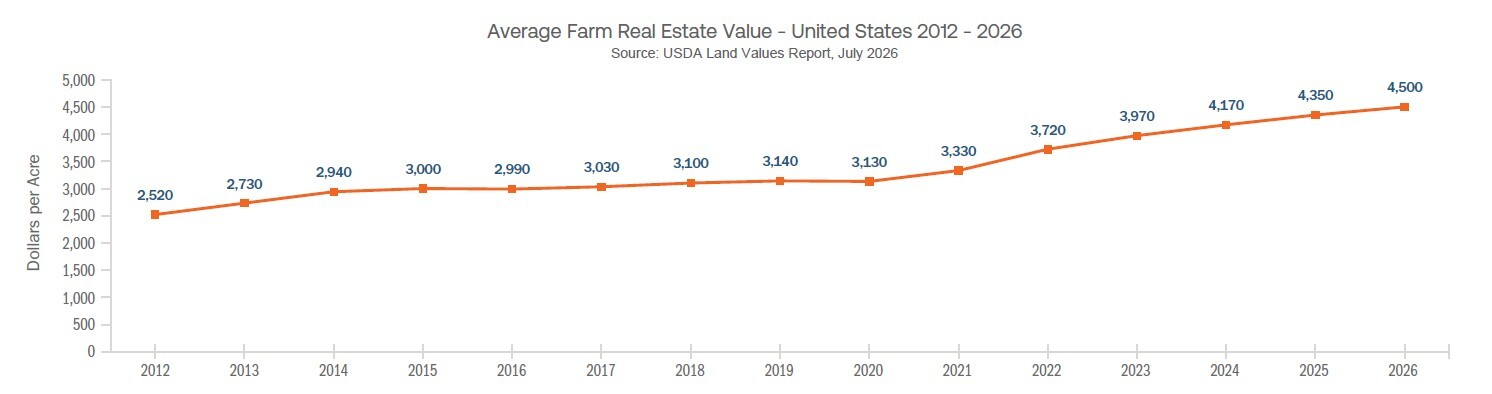
Land values continue to rise: The USDA's 2026 Land Values Survey showed U.S. farm real estate values increased 3.4% relative to 2025 to $4,500 per acre. This marked the sixth straight year of growth, continuing the steady appreciation trend observed since 2021. The gains were widespread across the country, but the strength of appreciation differed across regions. States with significant livestock and poultry production saw generally larger increases than areas more heavily dependent on row-crop production. In addition, non-agricultural factors provided a significant boost to farm real estate values in states such as Florida.
Cattle outlook improves: The USDA's July 1 Cattle report showed total U.S. cattle inventories at 94.2 million head, up slightly from 94.0 million a year ago. The increase was driven by a 1% rise in heifers weighing more than 500 pounds, signaling early signs of herd rebuilding. Additionally, the U.S. is expected to reopen the southern border to cattle imports by the end of August, providing additional support to the market. While supplies remain historically tight, these developments point to early signs of herd expansion as cattle prices continue to hover near record highs.
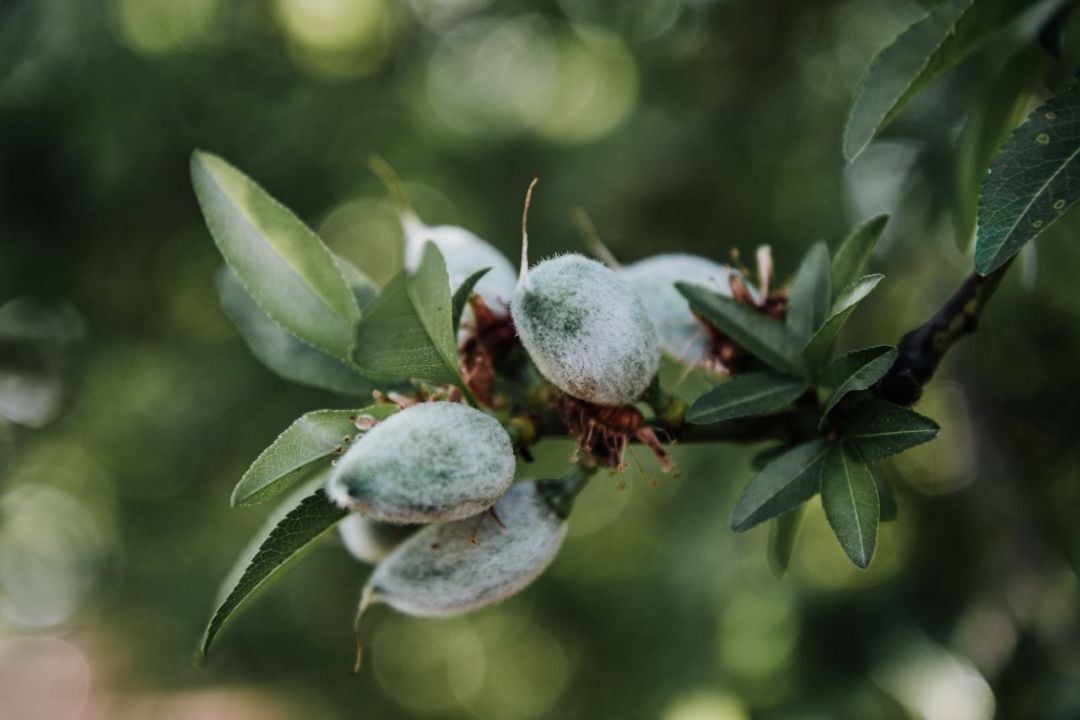
Almond market relief: Industry forecasts released this summer suggest California’s 2026 almond crop will be slightly smaller than previously expected, with estimates ranging from 2.64 to 2.67 billion pounds, below the USDA’s 2.70-billion-pound projection. Higher production costs, reduced inputs, and unfavorable growing conditions have weighed on crop expectations. While market activity has slowed recently, strong prices continue to provide support. Demand for inshell almonds remains firm, particularly from India, as growers prepare for harvest and the start of the new crop year.
Commodity Prices
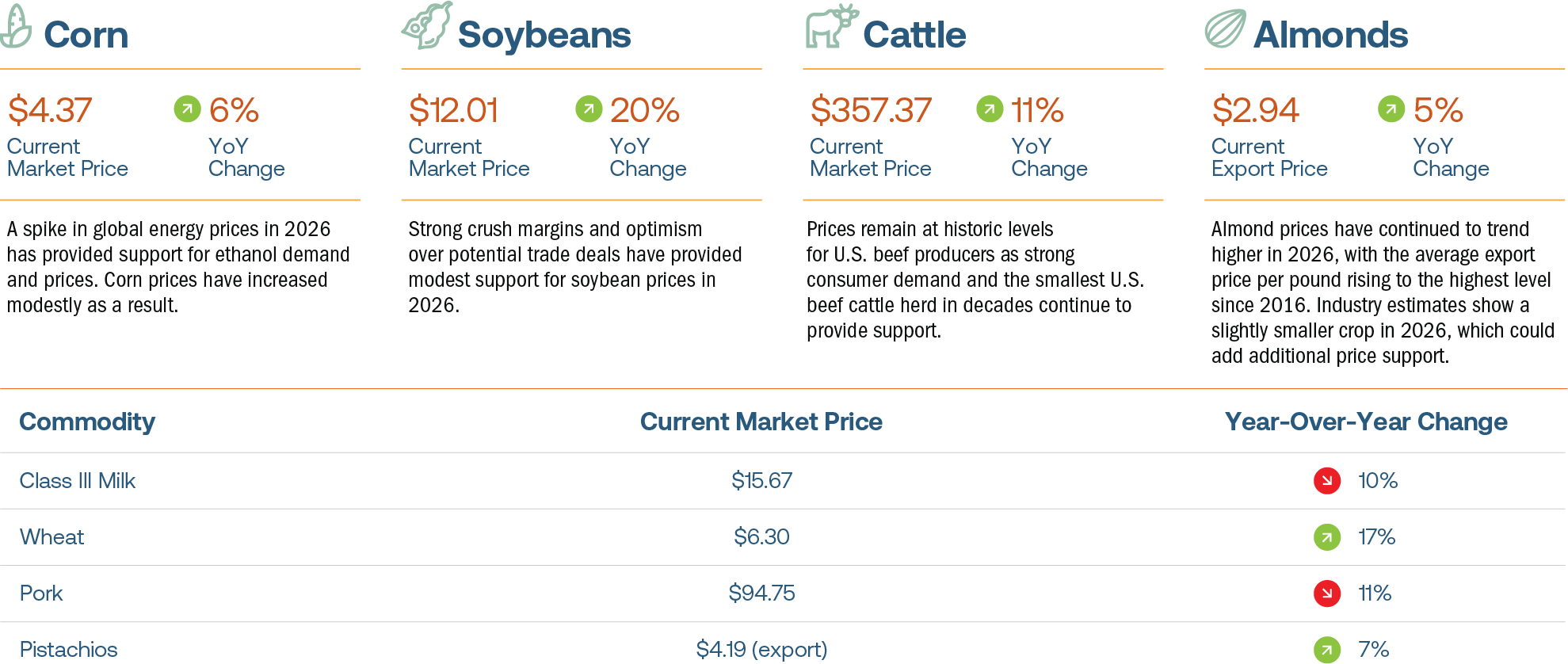
Source: USDA AMS Cash Price Reports; USDA FAS Export Data; CME Group. Data as of 7/13/2026
Note: Prices listed for almonds and pistachios are current export prices, not recent market prices, due to limited real-time market data for tree nuts.
Farmland Prices Shifting
The Farmer Mac Farmland Price Index powered by AcreValue® (FPI) is a proprietary index developed by Farmer Mac and AcreValue. It is built upon raw farm sales data on a per-acre basis, with each sale weighted based on the value of agricultural production within the property state.
USDA Report Illustrates Farmland Value Resiliency, but Farmer Mac Index Shows Headwinds Remain
The USDA released its annual Land Values report in August, which showed U.S. farmland values, on average, continued to rise in 2026. The average value of farm real estate per acre rose to $4,500 per acre, up 3.4% from $4,350 in 2025. Farmer Mac's national FPI also showed farmland sale prices rising nationally in Q2 2026. The FPI average was 5% higher in Q2 2026 than the previous year, even as prices remain relatively flat in several key agricultural states.
Markets With Increasing Prices: Regions with heavy cattle production are experiencing the most price appreciation as a result of historic cattle prices in recent quarters.
Markets With Stable Prices: Reports on farmland markets heavy in grain production indicate that they are experiencing price stabilization after multiple years of gains. For example, the Federal Reserve of Chicago reported farmland values in Q1 2026 moved both higher and lower within the region relative to price levels one year ago.
Markets With Price Pressure: Across many Western and Southwestern states, concerns about water availability and regulation combined with tighter grower profitability for numerous permanent crops have put downward pressure on farmland markets.
Contiguous U.S. Drought Monitor July 28, 2026
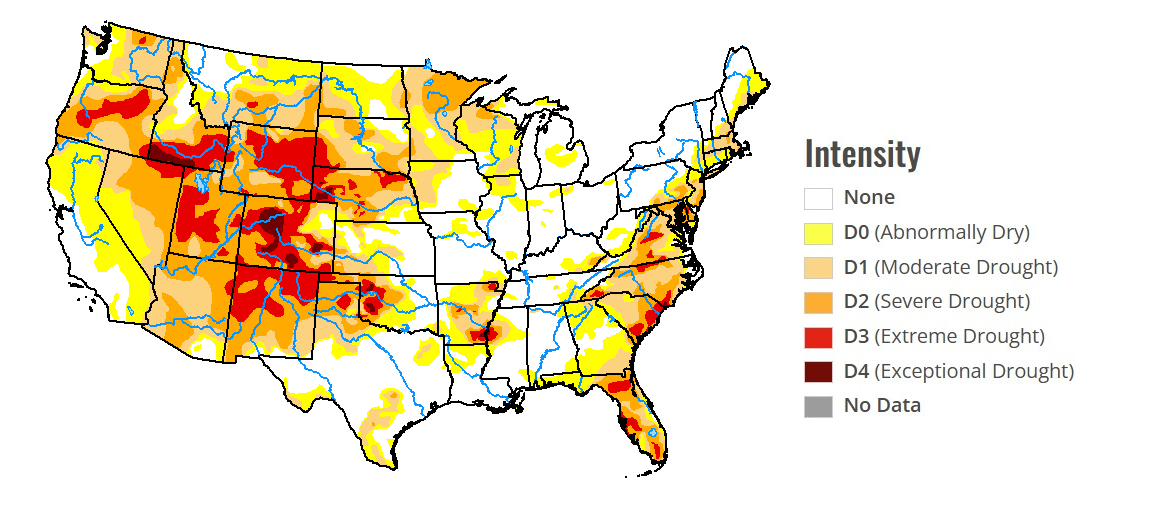 Source: Drought Monitor, University of Nebraska-Lincoln, NOAA
Drought conditions persist across much of the U.S. in 2026, though conditions have continued to evolve across regions. Drought remains most prevalent and severe in the West and Southwest. Conditions have been further compounded by historically low snowpack levels in the upper Colorado River Basin, limiting runoff into key reservoirs. As a result, Lake Powell and Lake Mead remain near their lowest levels since the 1960s. These challenges come as the seven Colorado River Basin states continue negotiations over future water allocation agreements set to take effect at the end of 2026. Drought conditions have abated somewhat in other regions, though. Heavy rainfall across Texas and the Delta in second quarter 2026 region has significantly reduced drought coverage in the South. Meanwhile, sporadic precipitation across the Midwest has left drought conditions moderate and sporadic across key annual crop producing states.
News / Headlines
Agricultural Fundamentals
“July USDA report hints at herd rebuild” AGDAILY, 7/29/26: The USDA's July cattle inventory report showed the first year-over-year increase in total cattle inventories since 2018, providing an early indication that herd rebuilding may be underway despite historically tight supplies.
“US Cropland Tops $6,000 per Acre for First Time in 2026” Farm Policy News, 8/3/26: National cropland values exceeded $6,000 per acre for the first time, reflecting continued strength in agricultural real estate despite tighter farm margins in some sectors.
“USDA Forecasts Slightly Smaller Almond Crop” Almond Board of California, 5/12/26: The USDA forecasts California's 2026 almond crop at 2.7 billion pounds, down 1% from the prior year, reflecting reduced bearing acreage and ongoing production challenges.
Trade Uncertainty
“US, Mexican officials to discuss agriculture, energy as Trump casts doubt on trade deal” Reuters, 6/16/26: Agricultural groups urged policymakers to preserve duty-free trade under USMCA as ongoing negotiations and the July review process extended uncertainty around North American agricultural trade.
Opinions, forecasts, estimates, projections and other views in this report constitute the current judgment of the author as of the date of this report, do not necessarily reflect the opinions of Farmer Mac or its management, and should not be construed as indicating Farmer Mac’s business prospects or expected results. The information contained in this report has been compiled from what Farmer Mac regards as reliable sources. Farmer Mac does not guarantee that the information provided in these materials is accurate, current or suitable for any particular purpose and Farmer Mac disclaims any responsibility for the information, third-party opinions, and data included in this report. Farmer Mac has no obligations to update, modify, or amend this report or to otherwise notify a recipient thereof if any opinion, forecast, or estimate contained herein changes or subsequently becomes inaccurate. Information from this report may be used with proper attribution. Alteration of this report or its content is strictly prohibited. ©2026 by Farmer Mac.
Related Insights

Webinar: The Future of Agricultural Lending: What Will Differentiate Winning Banks Over the Next Decade

Anatomy of the Big One: Red Flags in Large Ag Loans