


%20Net%20Yields.svg)



Annually, one of the best venues to gain a vantage point of the state of the agricultural banking industry and economy is the Agricultural Bankers Conference sponsored by the American Bankers Association. This year's conference was next to Lake Michigan in Milwaukee, Wisconsin. In my decades of addressing this conference, this was the third time it has been held in the city where Hall of Fame baseball great, the late Henry Aaron, got his start. The conference is an excellent opportunity to hear national speakers on an array of subjects impacting agriculture and the agricultural lending industry as well as to network with peers. The following were some of the discussion points that may provide a glimpse into the state of the agricultural economy.
Distressed Credits
Economic storm clouds are amassing as agriculture faces a triple threat, specifically for grain, row crops, and fruits. Lower commodity prices, stubborn inflated costs, and interest rates that are nearly double compared to a decade ago are contributing to losses on the income and cash flow statements and, in some cases, reducing asset values. As the agriculture industry consolidates, the losses are often six to seven figures, particularly when an accrual adjusted analysis is conducted accounting for declines in the value of inventories, increased accounts payable, and questionable accounts receivable. Declines in machinery and equipment values are very apparent in some areas of the country. Of course, sales of new equipment are down substantially. In a side conversation, one lender indicated that distressed client credits and foreclosures amount to over $300 million in their portfolio.
Economic volatility and uncertainty going into 2025 set the mood throughout the conference. Political stances and tariff posturing on technology and manufactured goods could impact agricultural trade. This may motivate lenders to analyze the loan portfolio more closely to determine which customers might be impacted the most and which have the management mindset to navigate the economic white waters.
The economic health of the United States’ big three trading partners (Canada, Mexico, and China) was also frequently discussed, as one out of every five dollars of agriculture net income is from exports. On the cost and input side, immigration policies were seen as a large risk in the fruit, vegetable, livestock, landscape, and processing industries. Some banks indicated that they are lowering loan advance rates on livestock, equipment, and land. Other lenders reported requiring more financial information be documented through farm and ranch visits and inspections.
The Missing Attendee
It was noticeable that new and beginning bankers with between two and ten years of experience were largely missing at this year's conference. Hallway conversations pointed out that there were not enough replacements to fill the positions of the many retiring agricultural lenders. Oftentimes, frontline people with little experience in fulfilling the agricultural lending role are being moved into these positions. Of course, tight budgets and the consolidation of the banking industry as a result of regulation and aging out of the industry are noticeable impacts.
Many bankers indicated that there are some smart, young bankers in the workforce. However, they felt many lack the interpersonal skills critical to the relationship lending desired by many agricultural and rural customers.
The 1980s Again??
Many bankers were commenting that the state of this economic downturn has some similarities to the 1980s, but is ultimately different. One lender jokingly stated that the “three Gs”s of lending were behind the 1980s farm crisis: good man, good loan, and good luck! In other words, character loans were the flavor of the day, with little reliance on financial information. Fast forward to today, when some loans are being made using silo lending, which is when a relationship officer initiates a loan while a credit analyst and the reviewers analyze the information for the loan committee for a quick approval. Each individual in the loan process functions in their own silo and there are often incentives for loan growth. Risk rating systems are tied to the default rate, which is a lagging indicator of the health of the agricultural portfolio and the individual customer. Losses of both time and money can quickly mount when servicing distressed credits where the relationship matters. Lenders may want to be diligent and ensure good communication occurs across the team to proactively identify any weak links and maintain consistent contact with borrowers.
Checklist for A Successful Ag-focused Bank
Considerable discussion centered on the importance of work culture to the success of a bank or any agricultural lending institution. What traits does a successful ag bank have, according to those bankers at the conference?
- Both the owners and board members are champions of the agriculture industry and rural communities.
- There are competent people in critical positions, including management, lending, and operations.
- Education and an advocacy mindset for the agriculture industry is a top core value.
- The bank “stays in their lane” as far as competency and expertise. (For a counter example: In 2008, some ag banks started making real estate loans outside of the ag market and outside of their normal market areas, which led to negative outcomes.)
- Support staff are considered some of the most important people and are empowered, supported, and passionate.
- The bank has a transition plan for when key individuals depart.
Other Key Points
Government payments carried agriculture, particularly in the COVID super cycle. According to the FINBIN data, government checks were approximately 60% of agriculture net income in 2020 and 26% in 2023.
The Women in Ag Banking Seminar at the conference focused on the need to establish boundaries to prevent burnout. Emails, texting, and calls should be off-limits during certain times of the day for recovery and regenerative time. If not, lenders risk burnout in their job and life, in general.
Craig Culver, the Co-Founder and Chairman of the Board of Culver’s, an American fast-casual restaurant chain, stated that his family started their fast-food food careers with a root beer stand in 1962 and, since then, their business has morphed into 1,000 restaurant franchises. What is the reported secret sauce?
- Know your partner.
- Be passionate about your business and customers.
- His experience in McDonalds’ training program taught him how to keep score.
- Hire people that have heart and attitude. Train for aptitude.
- A banker believed in his family when the financials were less than desirable. The banker and the family developed a defined workout plan.
- Give back to farmers, 4-H, and FFA, which are the roots of teaching life skills. If you ever visit or dine at their restaurants, you will see a number of pictures representing 4-H, FFA, and agricultural producers hanging on the wall.
Final Thoughts
While the agriculture industry is in an economic downcycle, there are some positives. Relationship lending, customer interaction, and good communication will separate those who are successful in agricultural lending. The downturn will accelerate the transition mode and will create opportunities for the next generation. As a veteran of many down cycles, I believe that lenders can build the best loan portfolio during down cycles because business and banking get back to the basics and it is all about relationships.
Lender and Business Dashboard Economic Indicator Assessment
Global Economy
The overall assessment of the global economy at year-end 2024 would be one that is in a slow growth mode, but outside the recession realm. On the other hand, the United States’ economy has had quite strong growth, with stellar paper wealth increases in the stock and real estate markets, cryptocurrency, and some commodities outside of agriculture.
China's stimulus programs for local governments have yet to increase consumption amongst their citizens. The slow growth of the export markets and asset corrections in the residential real estate and stock markets have resulted in very conservative consumption patterns. Plagued by slow growth in population demographics, the long-term trend does not bode well for the world's second-largest economy. Another significant trend for China and the Asian region is the general purchase of commodities inside and outside of agriculture from the Global South. Cheap oil and other commodities from Russia have assisted their struggling economy with cheaper inputs.
Japan and South Korea have observed a slowdown in their economies, which has resulted in political discourse. Keep an eye on this discourse, particularly if it spreads to other countries like Germany, Canada, Argentina, and Brazil. 2025 could be the year of political turmoil globally.
European unity is likely to be tested in 2025 by Russia. Germany, the third largest economy in the world, has experienced slower economic growth and layoffs in the manufacturing sector. Germany will likely continue to compete for global exports with China, the United States, and other nations.
Top Forecasted Issues in 2025 for the Globe:
- Immigration reform starting in North America, moving to Europe, and other nations.
- Wars in Europe and the Middle East may either escalate or reach a partial agreement with very little options in between.
- Artificial intelligence (AI) accelerates in use—with unintended consequences.
- Green energy initiatives, with government subsidies, are likely to slow down as innovation refines strategies. Moving forward, more priority is likely to be placed on the economic feasibility of green energy programs without reliance on government subsidies.
- Finally, global weather is forecasted to be in extremes, with extended dry periods followed by intense rainfall. This would put a priority on weather and climate resilience as long-term strategies.
Domestic Economy: Post-Election
The U.S. economy as of the end of 2024 appears to be a mixed bag. Layoffs are mounting in the agricultural sector and in some segments of major corporations. Credit card and consumer debt delinquencies are increasing to record levels and the national debt is increasing by $1 trillion dollars every 100 days.
At the time of this article, equity markets continue to boom. The same can be said for the cryptocurrency segment, as bitcoin moved above $100,000, up over 40% since the presidential election. This is resulting in a paper wealth sugar high for individuals who own these investments. The wealth effect happens when individuals feel emotionally richer, which positively influences spending and consumption patterns.
President-elect Trump, who finds enjoyment in negotiations, is establishing boundaries and negotiating with other countries, powerful industries, and businesses within the United States. This can create both euphoria and concern for those making purchase and investment decisions.
Economic Indicators
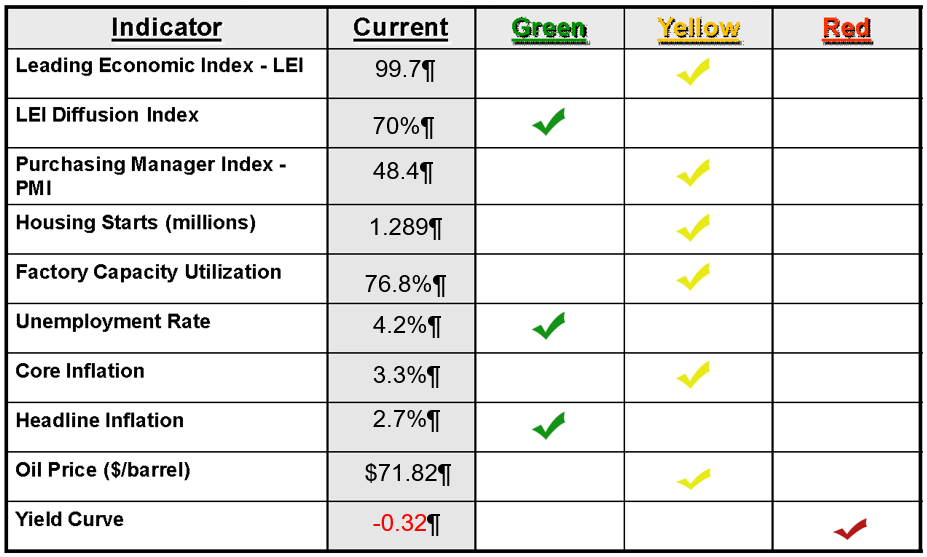
Year-end 2024 finds that the Leading Economic Index (LEI) for November increased for the first time this year. We will need to wait and see if this becomes a positive trend. The diffusion index has been above 50 for several months; however, the variables that make up the LEI are on the borderline when the final tally for the year is enumerated.
Oil and copper prices have been moderating, which benefits businesses and consumers. Gold prices are up over 25% this year, indicative of overall uncertainty.
The Purchasing Manager Index (PMI) is still in contraction mode and has been that way 11 out of 12 months in 2024. The index has been in the mid to high 40s range.
Unemployment numbers have been softening while job number increases have mainly been in government.
Housing starts are near 1.3 million units annually in the yellow zone. It will be interesting to see the impact of immigration reform and the possibility of increased inflation due to tariffs, labor costs, and the cost of money.
Factory utilization is steady in the high 70s while the inflation rate, as measured by the Consumer Price Index (CPI) and Producer Price Index (PPI), is very persistent. Higher insurance premiums, uncertainty in the labor market, and the cost of medical care are placing pressure on many households.
The Index of Consumer Sentiment, published by the University of Michigan, is still below 75. This metric measures consumer spending, which drives 70% of the U.S. economy.
The Dow Jones Industrial Average started the year at 38,150 points and peaked in December at over 45,000 points. There is an old saying that if it grows too fast, it is a weed. The holders of paper wealth better be aware!
LENDER AND BUSINESS DASHBOARD ECONOMIC INDICATORS
For the month of November
LENDER AND BUSINESS DASHBOARD ECONOMIC INDICATOR BENCHMARKS
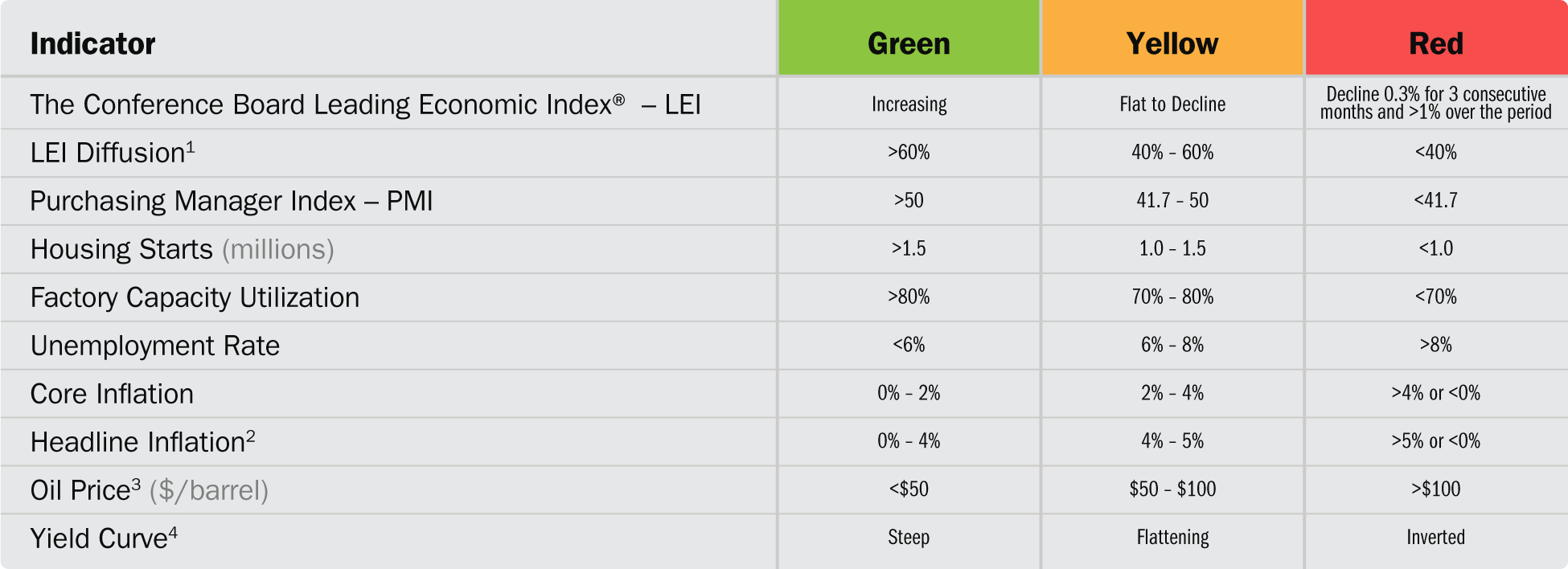 1Ten indicators make up the LEI - measures % that are increasing; 2Includes food & energy; 3Consumer’s perspective; 43-Month Treasury Bill rate to 10-Year Bond rate
About Dr. Dave Kohl

Dr. Dave Kohl is an academic Hall of Famer in the College of Agriculture at Virginia Tech, Blacksburg, VA. Dr. Kohl has keen insight into the agriculture industry gained through extensive travel, research, and involvement in ag businesses. He has traveled more than 10 million miles, delivered over 7,000 presentations, and published more than 2,500 articles throughout his career. His experience and engagement across all levels of agriculture provide a unique perspective on emerging trends and the future of the industry. Dr. Kohl is a valued and longstanding contributor to Farmer Mac's commitment to helping agricultural lenders, producers, and rural stakeholders navigate opportunities and challenges in a changing market. He writes exclusive articles for Farmer Mac that are published bi-monthly, offering timely insights on agricultural markets, rural economies, and business management strategies. In addition, Dr. Kohl regularly joins Farmer Mac's webinar program as a featured guest, sharing his expertise with audiences who are dedicated to supporting the long-term success of rural America.
Follow Farmer Mac on LinkedIn to receive the latest Dr. Kohl GPS article and stay informed about upcoming webinars featuring his insights and perspectives on the agricultural economy.
Opinions, forecasts, estimates, projections, and other views in this report constitute the current judgment of the author as of the date of this report, do not necessarily reflect the opinions of Farmer Mac or its management, and should not be construed as indicating Farmer Mac’s business prospects or expected results. The information contained in this report has been compiled from what Farmer Mac regards as reliable sources. Farmer Mac does not guarantee that the information provided in these materials is accurate, current or suitable for any particular purpose and Farmer Mac disclaims any responsibility for the information, third-party opinions, and data included in this report. Farmer Mac has no obligations to update, modify, or amend this report or to otherwise notify a recipient thereof if any opinion, forecast, or estimate contained herein changes or subsequently becomes inaccurate. Information from this report may be used with proper attribution. Alteration of this report or its content is strictly prohibited.
Related Insights

Webinar: The Future of Agricultural Lending: What Will Differentiate Winning Banks Over the Next Decade

Anatomy of the Big One: Red Flags in Large Ag Loans