


%20Net%20Yields.svg)



The 73rd American Bankers Association Agricultural Bankers Conference was held in St. Louis in November, drawing higher attendance and using a format designed to boost participation. A roll-call poll on the final day found that nearly 40% of attendees were first-year participants, and more women agricultural bankers attended than in prior years. Only a handful of bankers said they had attended the conference for more than 25 years, reflecting a broader trend: Many lenders who came up during the 1980s farm crisis have retired or are nearing retirement. Roundtable discussions during special engagement sessions generated ideas and solutions for common issues facing bankers and their customers.
Perspectives on Profitability Distribution
Jason Henderson, an agricultural economist and administrator at Iowa State University, said profits are likely to be more widely distributed among commercial agricultural producers. Pauline Van Nurden, who works with the University of Minnesota’s FINBIN farm financial database, said the data show a clear “goalpost effect” as farm revenue grows. On one side of the goalpost, larger farms are highly profitable, positioning them to expand— often by buying land from farmers who are retiring or struggling to transition the business.
Transition Challenges
For many farmers, major life events can accelerate succession and ownership challenges. Divorce after age 35 is often a common trigger, while others face the absence of an heir willing or able to take over the operation. Another group includes what some observers refer to as “the waiters”—non-farming children who postpone decisions until their aging parents or grandparents pass away, hoping to cash in on inflated assets. In these situations, siblings who are actively involved in the business cannot afford to buy them out. Bankers noted during the floor discussions that such dynamics are contributing to increasing mental health strain and, in some cases, a troubling rise in suicides among individuals caught in the middle.
Losses Among Large-scale Operations
On the other end of the goalpost are large-scale producers who are losing money, particularly in row crops and grains and in some cases specialty crops. In concurrent sessions at the conference, bankers discussed stricter underwriting by nontraditional lenders on operating lines, forcing traditional lenders such as the Farm Credit Banks and commercial banks to consider refinancing operating debt into term loans. Some bankers also voiced growing concerns about taking more land as collateral without a clear workout plan to help the customer reach breakeven or return to profitability.
A recurring theme throughout the conference was that farm businesses with less-diversified revenue streams— and those that rent or lease most of their land—were the most vulnerable. By contrast, operations with three to six sources of revenue, both farm and nonfarm, appear to be weathering the economic challenges more effectively
The Four Pillars of Profitability
The data presented by the University of Minnesota FINBIN team at the preconference session underscore a major trend in agriculture that bankers should monitor closely among their customer bases. Over a five-year period, the most profitable operations consistently exhibited four key characteristics.
1. Production Efficiency
Profitable operations were incrementally better than their peers at production management and overall efficiency, whether in crops or livestock. Some of these advantages can be attributed to higher-quality land or livestock, but much of the performance gap resulted from production methods and efficiencies that achieved the right balance between output and cost management.
2. Cost Management
A sustained focus on cost discipline distinguished top-performing producers. Over time, these operations achieved strong production results while maintaining lower input costs such as fertilizer, seed, and spray on the crop side, and feed and labor on the livestock side. Looking ahead, this level of analysis and scrutiny will become even more critical, particularly for rents and leases, as input costs remain elevated and margins tighten.
Bankers also emphasized the importance of managing overhead and fixed costs, as well as family living expenses. Scrutinizing family living expenses, where business and personal costs are often commingled, is essential. Lenders must also account for how many people draw income from the operation when establishing lines of credit. Bankers also noted that rising costs for insurance, real estate taxes, and child and adult care are contributing to “family living cost creep,” a trend increasingly evident in operating lines that cannot be fully paid down.
3. Marketing and Risk Management
Limited engagement in marketing and risk management emerged as a significant differentiator. Banker discussions were blunt: fewer than 20% of crop and livestock producers had any form of a marketing plan in place. FINBIN data reinforced the point, showing that over a five-year period, the most profitable farms received prices approximately 5% higher than their peers. Crop and livestock insurance coverage was also a defining characteristic of this profitable group.
4. Capital Efficiency
Effective use of capital was the final common thread among the most profitable operations. The data showed significantly lower machinery and equipment costs per acre or per livestock unit within this group. Banker discussions revealed that some customers are shedding underutilized assets, such as excess machinery and equipment, or collaborating with other producers to improve capital utilization.
All agreed that this renewal season will require a strong focus on these four pillars, regardless of where individual customers fall within the current economic cycle.
Other Insights
Artificial Intelligence in Banking
Artificial intelligence (AI) was a major topic of discussion at the conference. To use it effectively, users need to know how to write prompts, and then “trust but verify.” If AI is implemented within the bank, it requires clear process and strong buy-in, particularly from the bottom up among front-line team members who may feel threatened about job security. An informal survey of conference attendees found that fewer than 10% of bankers were currently paying for AI subscriptions.
Echoes of the 1980s
There were many echoes of the 1980s, with several comparisons to 2025, as trade disruptions and sanctions created challenges in both eras. The Soviet Union contributed to the agricultural bubble in the 1970s, just as China did in recent decades. Interest rates doubled in both periods, and debt expanded rapidly. Surprisingly, the beef market was red-hot in each era before the economic challenges emerged. The one saving grace this time is that land values have not crashed. However, land values are softening in parts of the South and in some regions of the western United States.
Women in Agricultural Lending
The women’s session struck a chord, with many participants saying that they enjoyed working with customers, their families, and their communities. Some said they felt overwhelmed at times but emphasized that mentorship had been essential to their success. Others noted that as banks merge, cultural differences between commercial lending and agricultural lending can create tension. They said the art and science of agricultural lending, which includes many “gray areas,” can be difficult to convey to commercial lenders. Delegation was another challenge participants identified, with several women saying they often felt held to a higher standard than their male counterparts.
Shout Out
I would like to congratulate Patrick Kerrigan, Vice President of Farm & Ranch Business Development at Farmer Mac, on receiving the Blanchfield Award for service to agricultural banks.
Patrick ability to build relationships and connect with people was evident long before his career in agricultural finance. He played basketball for New York University and toured with the Washington Generals, competing against the Harlem Globetrotters for three years. That experience required teamwork, adaptability, and an ease connecting with people from many different places—qualities that continue to serve him well in his professional career. In his work with ag lenders today, Patrick is widely respected for his approachability and relationshipbuilding skills, working closely with lenders across a wide range of geographic regions and cultures. His listening abilities, problem-solving mindset, and capacity to innovate, while genuinely caring about people as individuals, are rare qualities in today’s world.
Through his leadership, Farmer Mac has expanded its network and portfolio, strengthening its support of agricultural lenders, farmers and ranchers nationwide. On a personal note, I have enjoyed discussing basketball, fishing on the Salmon River in upstate New York, and just about everything else under the sun with him. Patrick, you are a very special professional and person who truly deserves this award.
Lender and Business Dashboard Economic Indicator Assessment
December 2025
Global Economy
The global economy appears to be navigating tariffs, sanctions, and geopolitical agendas that are resulting in slow growth. A major storm cloud on the economic horizon is the significant buildup of debt among many major economic powers. Bankers should consider not only the absolute level of debt, but also the accelerating pace of that debt accumulation since the COVID and post-COVID eras.
China’s economic growth has declined due to reduced exports to the United States and, to some degree, other Western nations. While China’s producer price inflation continues to decline, recent upticks in consumer inflation have made headlines. A quandary is that deflating home and stock values, along with declining prices for manufactured and technology products, are challenging both Chinese citizens and the government. At the same time, prices of consumer goods are increasing, pinching household budgets and negatively impacting retail sales.
Japan
Over the next few months, watch Japan on two fronts. The new administration is advancing an aggressive economic policy that includes stimulus and reforms. Combined with strategic investment and a military buildup, Japan’s more assertive stance toward China has raised concerns across the Asian region.
Second, keep an eye on the Japanese bond market. In recent weeks, even a small increase in yields has sent important signals about Japan’s economic outlook, particularly given that Japan’s debt-to-GDP ratio exceeds 200%. A small rise in yields increases debt service costs for an already sluggish economy, affecting Japan directly and sending ripples through the global economy, especially in the United States, which is highly active in global capital markets to fund maturing bonds and Treasury securities.
Europe
In Europe, the major economic powers—Germany, France, and Great Britain—are struggling while simultaneously facing a concerted effort to increase military spending. Germany’s auto and manufacturing industries are finding it increasingly difficult to compete in export markets against China’s autos, technology and manufactured products. France is dealing with political challenges, combined with budget issues in Great Britain, creating headwinds for this region, which accounts for roughly 20% of the global economy.
U.S. Economy
This report on the U.S. economy will be abbreviated because the government shutdown has led to limited and inconsistent data. In this year-end article, I will offer perspective gleaned from my travel in 30 states and discussions with a wide range of groups. Their comments will include a broad range of outlooks, from negative to positive.
Storm Clouds
Beneath the glow of the stock market, several potentially negative trends are emerging in both government and private-sector data. Housing and real estate prices are now leveling off or declining, particularly in the southern United States. Examples include southwest Florida, Austin, Nashville and Phoenix. Homes are staying on the market longer, and seller incentives are becoming the norm, such as paying closing costs or offering upgrades.
In contrast, in the northern tier of the country, home values are still increasing. The key issue is affordability—not just mortgage payments but insurance, real estate taxes and other homeownership costs. Approximately one in seven jobs in America is connected directly or indirectly to real estate. That affects the overall economy and could become a catalyst for a recession.
Recent layoffs in the white-collar sector are thinning the workforce as employers bet AI will replace certain jobs. The unemployment rate for recent college graduates has increased sharply, and many seeking their first job are being “ghosted” by employers. Recent language in the Federal Reserve’s minutes suggests growing concern, and I am also observing these trend1s.
Positives
The stock market continues to move higher, driven by strong earnings from large companies, stock buybacks and enthusiasm about the potential benefits of AI. How much longer this momentum will last should become clearer in early to mid-2026.
Interest rates will most likely decline as a result of new appointments at the Federal Reserve and encouragement from the current administration. This will be a tricky balancing act, as inflation must be managed alongside lower interest rates. Any rate reductions are likely to occur at the short end of the yield curve, directly impacting operating loans. However, a lack of fiscal discipline could complicate funding of long-term bonds and Treasuries. A potential liquidity crunch would be a negative jolt to the economy.
The benefits of the new tax law changes are another positive. However, many businesses and industries are hesitant to make long-term investments based on these changes due to ongoing uncertainty and frequent shifts in tariffs and sanctions, which make strategic planning difficult.
Lead and Lag Economic Indicators
Many of the normal economic indicators are not available, so this analysis relies on the most recent usable data.
-
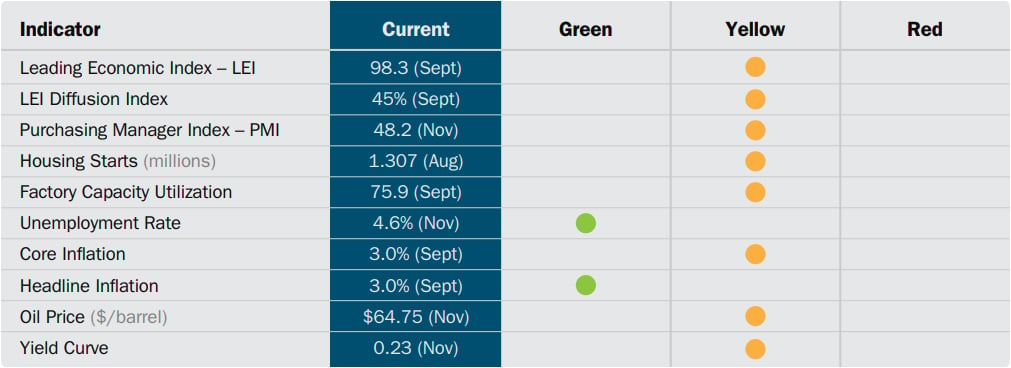
A positive sign for the economy is that oil prices have been down more than $15 per barrel since the beginning of the year.
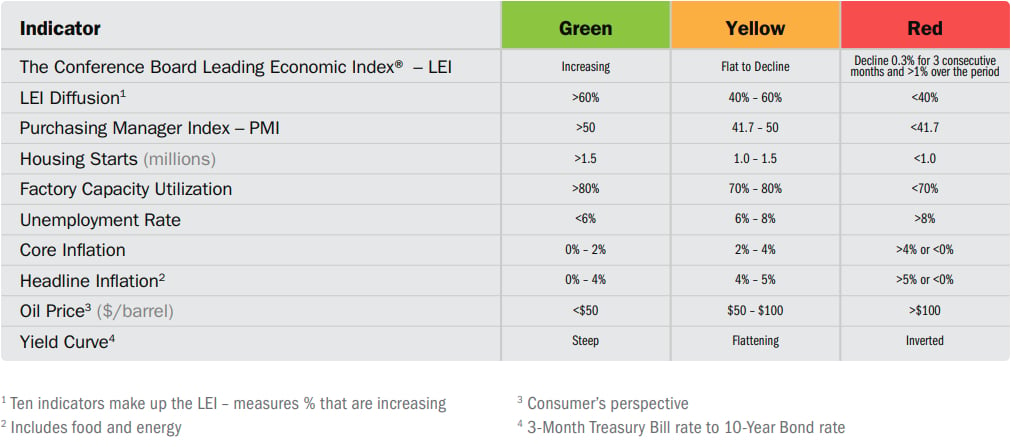
- Gold and silver prices have surged as foreign countries continue to move away from the U.S. dollar and into hard assets. Copper prices also remain strong, as some manufacturing sectors and economies are stockpiling reserves amid global and geopolitical uncertainty. The PMI, or Purchasing Managers’ Index, remains below 50, signaling a sluggish manufacturing economy. Combined with factory utilization rates in the mid-70% range, the data suggest these sectors are operating in a slow but stable mode. Housing starts remain below the preferred benchmark of 1.5 million units annually. Housing appears to be in a declining phase, which could have broader implications for overall economic growth. Core inflation remains above the ideal target of 2%. However, headline inflation has improved due to lower oil prices.
- Consumer sentiment, as measured by the University of Michigan, has rebounded slightly from the lows of this fall but remains below 75. This indicates that consumers continue to struggle with inflation, job security concerns, and an overall uncertain outlook.
Lender and Business Dashboard Economic Indicators
For the months of November 2025 (Latest data as of Dec. 18, 2025, due to the government shutdown)
Lender and Business Dashboard Economic Indicator Benchmarks
About Dr. Dave Kohl

Dr. Dave Kohl is an academic Hall of Famer in the College of Agriculture at Virginia Tech, Blacksburg, VA. Dr. Kohl has keen insight into the agriculture industry gained through extensive travel, research, and involvement in ag businesses. He has traveled more than 10 million miles, delivered over 7,000 presentations, and published more than 2,500 articles throughout his career. His experience and engagement across all levels of agriculture provide a unique perspective on emerging trends and the future of the industry. Dr. Kohl is a valued and longstanding contributor to Farmer Mac's commitment to helping agricultural lenders, producers, and rural stakeholders navigate opportunities and challenges in a changing market. He writes exclusive articles for Farmer Mac that are published bi-monthly, offering timely insights on agricultural markets, rural economies, and business management strategies. In addition, Dr. Kohl regularly joins Farmer Mac's webinar program as a featured guest, sharing his expertise with audiences who are dedicated to supporting the long-term success of rural America.
Follow Farmer Mac on LinkedIn to receive the latest Dr. Kohl's GPS article and stay informed about upcoming webinars featuring his insights and perspectives on the agricultural economy.
Opinions, forecasts, estimates, projections, and other views in this report constitute the current judgment of the author as of the date of this report, do not necessarily reflect the opinions of Farmer Mac or its management, and should not be construed as indicating Farmer Mac’s business prospects or expected results. The information contained in this report has been compiled from what Farmer Mac regards as reliable sources. Farmer Mac does not guarantee that the information provided in these materials is accurate, current or suitable for any particular purpose and Farmer Mac disclaims any responsibility for the information, third-party opinions, and data included in this report. Farmer Mac has no obligations to update, modify, or amend this report or to otherwise notify a recipient thereof if any opinion, forecast, or estimate contained herein changes or subsequently becomes inaccurate. Information from this report may be used with proper attribution. Alteration of this report or its content is strictly prohibited.
Related Insights

Webinar: The Future of Agricultural Lending: What Will Differentiate Winning Banks Over the Next Decade

Anatomy of the Big One: Red Flags in Large Ag Loans