


%20Net%20Yields.svg)


There is no doubt that American agriculture is consolidating. Whether driving across the rural areas of America or viewing the recent census data, it is clear that larger farms and ranches are the trend. This change in the landscape can be a challenge for the agricultural lending team when analyzing risk and opportunities. In this position of the economic cycle with lower prices, stubborn inflated costs, and higher resistant interest rates, decisions on individual credits and the portfolio makeup become even more critical.
With more zeros and commas on the balance sheet, income statement, and cash flow, getting it right regardless of the economic cycle is critical. When macroeconomic variables align in a positive direction, windfall profits can be made on these larger operations. This can lead to complacency and poor decision-making if the fundamentals of management and finance are not followed. At the other end of the spectrum, losses can spin out of control very quickly when less than ideal economic conditions, such as those that exist today and possibly in the near future, are present.
The past three years of the mini-super cycle have given a false impression of true profitability. Initially, the pandemic led to high agricultural prices coupled with low costs and interest rates, which resulted in record profits. The generosity of government stimulus payments allowed producers to reduce operating lines of credit, paydown term debt, and make capital purchases, particularly land.
The Reality Sets In
As discussed in previous Dave’s GPS articles, those days are in the rearview mirror with no end in sight concerning the margin squeeze. When it comes to farm and ranch size, increased monitoring of individual customers and the overall portfolio will likely be a high priority in 2024 and 2025. Businesses generating over $500,000 in revenue may need more intense monitoring and often the vague attribute of credit called management must be objectively analyzed. These businesses can result in a portfolio rapidly deteriorating, hindering the institution's performance.
The Goalpost
What is interesting among large producers in terms of revenue is what the FINBIN team from the Center for Farm Financial Management at the University of Minnesota calls “the goalpost” of profits and performance. Large entities in the top 20% of profitability can generate considerable profit during strong economic times but can also maintain profitability when the macroeconomic cycle goes in reverse. These businesses are dialed in on management. This is analogous to a flywheel. If everything is in sync, then profits accelerate.
If a few of the management cogs are missing, then the opposite end of the profit and performance spectrum can be true. The bigger the business, the more the losses can compound, which can quickly mean drawing on working capital and equity reserves or result in a loan refinance request.
The Fork in the Road
There is an old saying that growth and the inability to apply business acumen are the top reasons that businesses fail. Analysis of the 2023 FINBIN data shows how size, in terms of gross farm revenue and profits, provides evidence to the statement. The top 20% of profitable farms that generated more than $2 million in annual revenue earned approximately $920,000 in profits in 2023. The median group reported $219,000 of profits. The bottom 20% of performers had a staggering $360,000 of losses. This illustrates that the down cycle can quickly expose management weaknesses. Once-per- year financial reporting for tax management using a Schedule F often does not provide a true picture of profitability or how quickly it is changing. As the late Yogi Berra, a famous Yankee catcher, was often quoted, “When you come to a fork in the road, take it!” However, when it comes to profit and performance, the high road can be linked to management while the low road, or bottom 20%, can be correlated to the inability of business owners and managers to plan, strategize, execute, and monitor.
Business Acumen
The challenge for lenders in the margin squeeze era is going to rest on their ability to size up management in an objective manner. The business IQ scorecard that my team and I developed about a decade ago can be a tool for the times to assess management skills. The 15 questions that are completed by both the producer and lender can provide a format around the complex issue of sizing up management of the business. This tool has been tested on the University of Kentucky farm record database over a five-year period. When segmented by the top, median, and bottom third results, the higher the score, the stronger the financials, as measured by the return on assets (ROA), debt service coverage ratio, operating margin, and debt to asset ratio.
The business IQ format is not only useful in management assessment, but it can be used internally and externally by employees and for customer communication. Loan narratives can be developed and a plan for improvement could be initiated based on the business IQ.
The top 20% of producers often know their cost of production and breakeven point overall, but also by enterprise. They will often conduct financial sensitivity analysis with different production, price, and cost scenarios to provide a spectrum of possibilities in objective decision-making.
Another important part of the business IQ scorecard analysis is the producer developing a projected cash flow. This can be an important management tool when conducting variance analysis, i.e., when comparing actual results to projections. Again, scenario planning can provide a range of possibilities and outcomes to determine whether debt service requirements can be achieved.
One of the key management factors I often see in the top 20% of producers is objectivity while executing marketing and risk management programs. These producers use cash flow statements and enterprise cost analysis to determine the level of coverage needed and risk or the possibility of using options for marketing. Ego and complacency are replaced by objectivity when the plan is followed and monitored by the cash flow statement.
Another attribute measured by the business IQ assessment is the use of key performance indicators (KPIs). The top 20% of producers often use KPIs to measure success and, in some cases, the KPIs are a part of their key financial ratios. The debt service coverage ratio, working capital to expenses, net profit margin, and the asset turnover ratio, which measures asset efficiency, are often common metrics used by top producers.
The top 20% of profitable producers and those in the median group will often utilize a formal or informal group of advisors. The advisory team often includes the lender, the livestock or crop consultant, or a marketing and risk management coach.
If one uses the tool, what is a good score? I jokingly call it the “Steph Curry 30,” named after the NBA star of the Golden State Warriors. Usually, the median or top groups will score somewhere between 30 and 38, with evidence of implementation and practices. The bottom 20% of producers will score between 23 and 28.
This is the time for ag lenders to proactively monitor their customers and loan portfolio. While it often takes more time, the benefits can be measured in enhanced relationships and improving the business acumen of customers.
Lender and Business Dashboard Economic Indicator Assessment
June 25, 2024
Global Economy
The global economy is immersed in major elections, which could impact agriculture trade, sanctions, tariffs, and supply and demand balances. This is extremely important for the agriculture industry because exports generate one in five dollars of net farm income. Earlier in the year, elections in Taiwan and Russia did very little to move the global perspective because the outcomes were in line with what was expected.
India, the most populous country in the world, had a six-week election process concluding with the existing leader being reelected for an unprecedented third term. His agricultural protectionism stance could impact world trade, particularly for crops like rice, sugar, wheat, and onions, as his goal is to feed his population first. India's economy is growing at a 7% rate, which makes it one of the fastest growth rates of major countries in the world.
Mexico just elected its first female leader with a clear majority. Her leadership will start in October and is expected to follow the previous president’s philosophy, which has been to assist the poor and attempt to curtail some of the 100 gangs that control the southern part of Mexico. She was the former mayor of Mexico City and has a very popular following. Because Mexico is one of our top importers of agricultural products and a source of labor for the agriculture industry, our leader's interaction with her is going to be a high priority. On a side note, my interaction with a group of Mexican bankers at the Graduate School of Banking at Louisiana State University found an interesting note. They suggested that some of the most productive land in Mexico in the more popular agricultural pockets is being bought by South Koreans.
China, one of our major agriculture trade partners, has been levied another round of tariffs on technology and automobiles. Later this year, it will be interesting to determine whether retaliation will occur for agricultural goods from the United States. The economic slowdown in China continues because of demographic issues. The aging population places stress on adult care, medical care, and overall costs to the government, which is heavily in debt. The Chinese housing and stock markets continue to struggle, with both down 35% to 40%. The government is loosening credit standards at the banks to stimulate consumer and investment spending. China is rapidly reducing purchases of U.S. government debt. At one time, China was the largest foreign investor of U.S. debt at over $1.3 trillion. Now, this figure is in the $500 billion range. The Chinese are also purchasing gold reserves and putting strategic efforts toward an alternative currency to compete against the U.S. dollar.
The European region has pulled out of recession territory with small positive growth. The wars in Europe and the Middle East are challenging European unity and economic support. Resistance to the green energy movement is still on the agenda in many of these countries. We expect Europe to cut interest rates before the U.S. as inflation has subsided in many areas.
Domestic Economy
Many participants at the Graduate School of Banking at Louisiana State University questioned when interest rates are going to decline. The Federal Reserve is being very measured about changing interest rates. Their credibility has been challenged as a result of their slow reaction to inflation during the pandemic. Next, the fact that we’re moving into the later part of the presidential election cycle in the U.S. suggests that the Federal Open Market Committee, which determines rates, is likely to be very guarded and cautious in the decision-making process.
The senior level class at the Graduate School of Banking was surveyed concerning when the next recession in the U.S. will start. Eighty percent suggested that a recession would begin in the first or second quarter of 2025. Ten percent indicated that the U.S. was already in a recession and another 10% said a recession would be in 2026 or later.
The growth of consumer credit card debt is the highest since the 2000s and the high rates of delinquencies suggest that there is a household liquidity issue. The consumer segment called ALICE, i.e. asset limited, income constrained, and employed (often part-time employment), are under financial stress. This has shown up in sales at McDonald's and Starbucks, which are down over 5%.
If the financial squeeze moves to a higher income level and wealth sector, then a recession could quickly materialize. Stagflation, which is gross domestic product growth under the rate of inflation, is providing a pessimistic outlook for many segments of the economy.
Leading and Lagging Economic Indicators
One of the major questions from the participants at the Graduate School of Banking at Louisiana State University was whether the leading and lagging indicators of the economy are working and if they should be disregarded.
In a nutshell, the double barrel approach of stimulus from both the Federal Reserve and government has provided an unprecedented boost to the economy. For example, the pandemic stimulus in a two-year period was four times greater in real dollars than the post-World War II Marshall Plan, which was designed to reconstruct Europe and parts of Asia. This, compounded with loose monetary policy and historically low interest rates, impacted the timing of these indicators. Once it is all said and done, these indicators are still relevant and continue to need to be monitored.
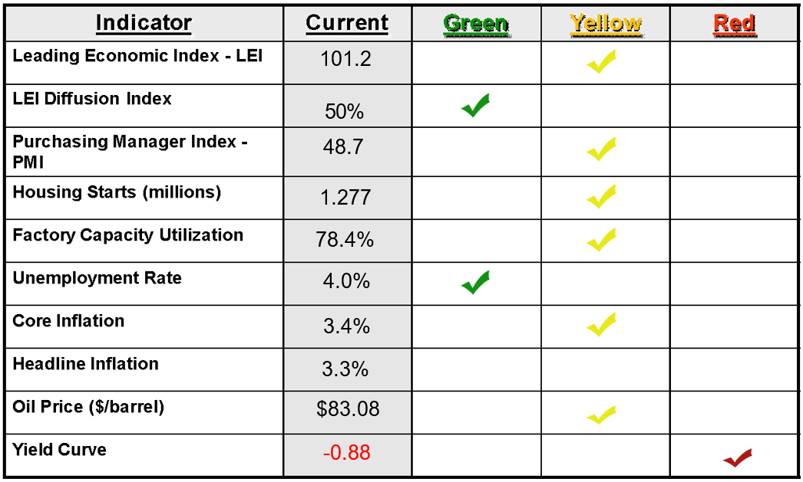
The Leading Economic Index (LEI) is still suggesting slow economic growth. However, in recent months the index was down six-tenths of one percent. If the LEI is down more than three-tenths of one percent for the next two months, then there is a possibility of a recession later this year or in 2025. The LEI diffusion index, which measures whether the ten factors comprising the LEI are trending positive or negative, is in the 40 to 50 range, another sign of economic stress.
The Purchasing Manager Index (PMI) has been under 50 for the past two months, suggesting a contracting economy, but is above recessionary levels.
Unemployment figures, both the U-3 and U-6 rates, are still strong. However, much of the job growth has been part-time employment, while full-time employment has been negative.
Housing starts are still under 1.5 million units annually, a moderately strong metric. High interest rates and the high cost of land and materials have challenged housing starts.
Some of the large builders like Toll Brothers are offering interest rate buydowns to encourage homeownership. The median home price in the U.S. is above $400,000 and requires a 38% debt service to income ratio, which is well above suggested underwriting standards. The ability to qualify for homeowner’s insurance in some states and inflated insurance premiums have also been an issue challenging home ownership.
The core inflation rate is still high at more than 3% because of housing and medical costs, which make up a large percentage of this metric. Some people call this the “super core" and it has been a struggle to reduce. Watch for more discussion on whether the 2% inflation target is appropriate.
Finally, the Index of Consumer Sentiment has moved back into the danger zone less than 75 after months above this level. While one month is not a trend, vigilance in this metric over the summer will need to be a priority.
LENDER AND BUSINESS DASHBOARD ECONOMIC INDICATORS
For the month of May 2024
LENDER AND BUSINESS DASHBOARD ECONOMIC INDICATOR BENCHMARKS
Related Insights


Refinancing Dilemma: Lender & Borrower