
The discovery of Mad-cow disease in Brazil is likely to disrupt the global beef trade. However, a contracting U.S. beef cattle herd means foreign buyers may look outside of the U.S. to replace Brazilian beef. Brazil suspended beef exports to China last week after a cow tested positive for bovine spongiform encephalopathy, more commonly referred to as mad-cow disease. This disease can spread to humans through the consumption of tainted beef products and can be fatal. As such, China and other major importers have historically halted beef purchases from countries where the disease is detected.

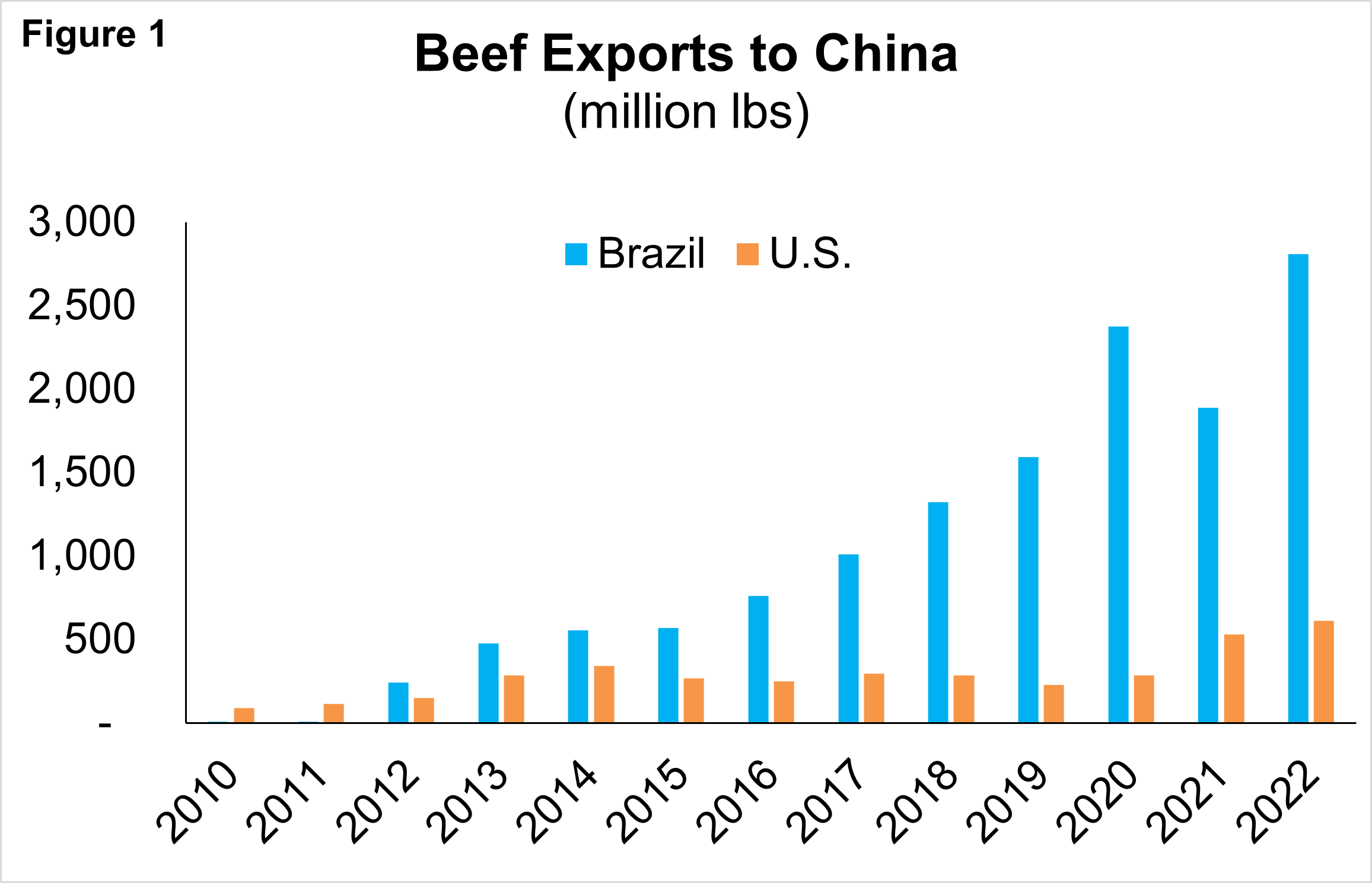
Suspending beef imports from Brazil could lead to greater demand for U.S. beef. Figure 1 shows historical beef export volumes to China from the U.S. and Brazil. The U.S. exported greater quantities to China as recently as 2011. However, the dynamic has completely shifted and Brazilian beef exports to China have dwarfed the U.S. in recent years. The U.S. exported a record 600 million pounds of beef to China in 2022, which was only 22% of what Brazil exported. Still, the last time mad-cow disease was discovered in Brazil was 2021. It resulted in a four-month export ban and contributed to the 21% year-over-year decline in Brazil’s beef exports to China. At the same time, U.S. beef exports to China increased 87% yoy in 2021. An extended suspension on Brazilian beef could therefore cause China to look elsewhere to source imports from. 
 

A contraction of the U.S. beef sector will limit the ability of U.S. producers to backfill China’s supply gap. Total beef cattle inventory declined by 2.8 million in January relative to last year. This was the largest decline since 1989 and is attributable to several factors including high feed prices and drought conditions. The ongoing drought across the southern and western plains has caused a decline in pasture conditions and led many producers to sell their cows. Producers may choose to expand their herds again if the ban on Brazilian beef leads to an uptick in export demand and prices for U.S. beef. However, there is a considerable lag associated with expanding beef production in comparison to other livestock sectors.


Opinions, forecasts, estimates, projections, and other views in this report constitute the current judgment of the author as of the date of this report, do not necessarily reflect the opinions of Farmer Mac or its management, and should not be construed as indicating Farmer Mac’s business prospects or expected results. The information contained in this report has been compiled from what Farmer Mac regards as reliable sources. Farmer Mac does not guarantee that the information provided in these materials is accurate, current or suitable for any particular purpose and Farmer Mac disclaims any responsibility for the information, third-party opinions, and data included in this report. Farmer Mac has no obligations to update, modify, or amend this report or to otherwise notify a recipient thereof if any opinion, forecast, or estimate contained herein changes or subsequently becomes inaccurate. Information from this report may be used with proper attribution. Alteration of this report or its content is strictly prohibited.

Related

Related Insights


Farmer Mac Loan Exchange Training

Webinar was held on July 15, 2026
15 July, 2026
2 min read

Refinancing Dilemma: Lender & Borrower

In my travels this year across more than 25 states and through discussions with lenders and borrowers, a common question continues to surface: Is the...
10 June, 2026
2 min read

Reading the Field: An Agricultural Lending Assessment for 2026

Agricultural lenders and producers are operating in an increasingly complex economic environment, and the stakes continue to rise for understanding...
10 May, 2026
2 min read